Pre-processing
Pre-processing options improve the quality of a data file or prepare it for correct use by the system. They are chosen before starting the project and run in sequence.
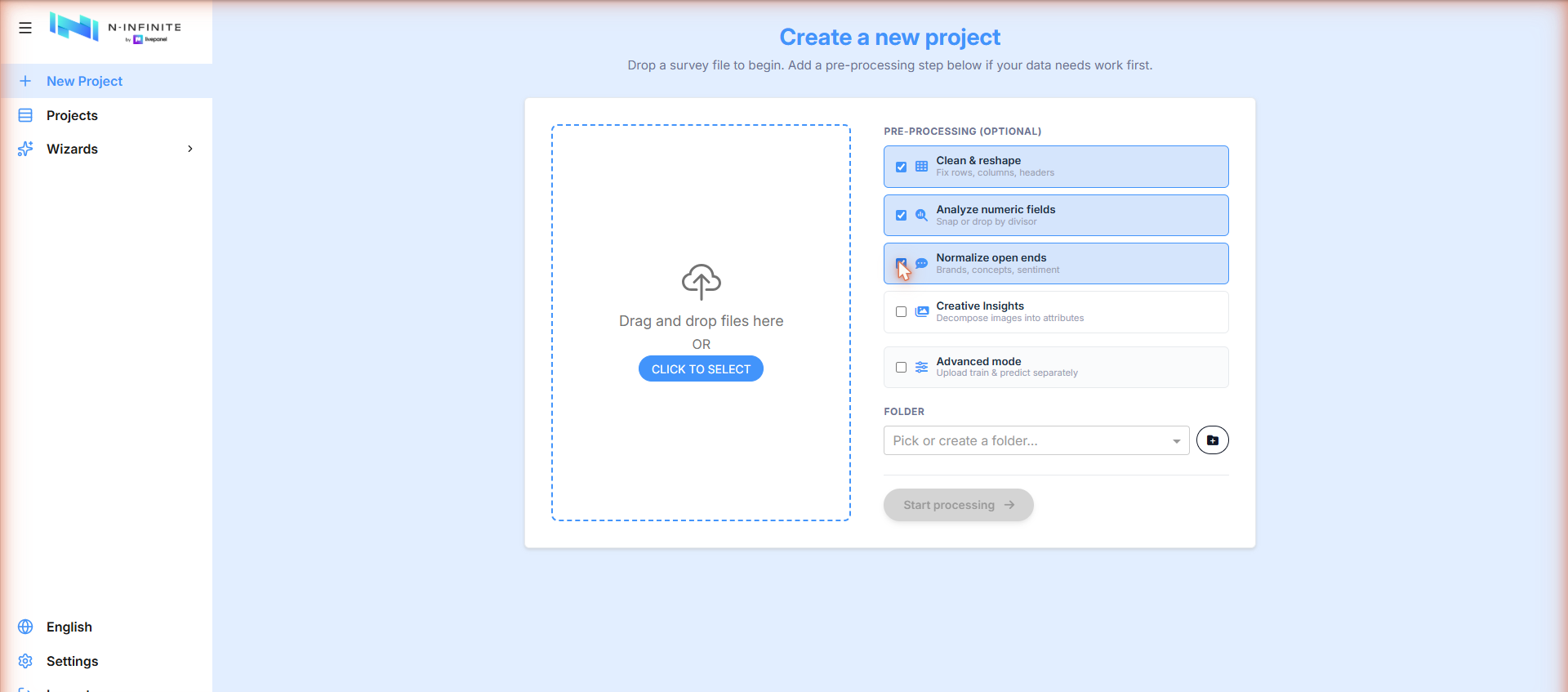
Clean & Reshape
Adjusts your data regardless of its source format, in four steps:
1. Row deletion
Remove empty rows, or the duplicate header row when a file has two header rows per column — it is recommended to keep the coded headers.
2. Questionnaire definition
Indicate where the questionnaire begins and ends for training and response prediction. Columns located after the end of the questionnaire are automatically moved to before the first question.
Completely empty rows are detected as profiles to predict.
The Complete / Incomplete switch:
- Enabled — all uploaded rows (except completely empty ones) are valid rows that meet the questionnaire's skip logic.
- Disabled — the tool assumes any row may be incomplete and will predict up to the last column, using data from complete rows in each column for training.
3. Column deletion
Delete columns that serve no profiling or prediction purpose: checksums, start/end times, other row identifiers.
4. Auto Clean
Simplified deletion of profiling columns with no diversity (monolithic values) or low coverage/density. We recommend processing files with 50–100 profiling columns at most.
Numeric Preprocessor
Analyzes and adjusts numeric columns: round values, or delete values that do not align with the questionnaire logic or with what is expected for that type of question.
Open Text Normalizer
Normalizing text responses is a priority in machine learning: uniformly distinguishing each brand, or grouping key concepts, lets the models better interpret each data point. n-Infinite offers three types of normalization:
- Brands — groups all brand mentions while mitigating variations such as
typos or case differences. The AI Suggest button generates category
labels by analyzing the existing mentions. If one response mentions several
brands, they are separated with the
~character. Multiple columns can be concatenated under the same criteria. - Concept — analyzes each response and groups them conceptually, up to a
user-defined maximum number of distinct concepts. AI Suggest helps
generate category labels from a sample of responses. Multiple concepts in
one response are separated with
~. - Sentiment Suite — deconstructs responses into sentiment variables, keywords and core response elements, enabling ML prediction and the regeneration of unique open-ended responses sensitive to each panelist's context.
Optionally, you can then choose the columns that define age, gender and country/region to focus the analysis.